
When The Scoreboard Lies
Jules Heartly | August 2025
There are sports I enjoy practicing and there are others I just love to watch. Tennis being at the top of that list.
I would say my calendar revolves around the grand slam schedule and when in town I cant miss the #USopen.
There is always something to learn and to admire from watching these professional tennis players. As when watching any live sports, we know all is mostly unscripted, anything may happen in real time. And experiencing every twist, surprise and dramatic moment as it unfolds is part of the reason we are drawn to the event. Not to mention the adrenaline rush from a close game or how a big play may elevate one’s mood, providing excitement and why not stress relief. But it could also bring Inspiration and create memories that may last long enough to trigger a positive change in one’s life.
And perhaps it was what happened in a recent US Open qualifiers match between Rei Sakamoto from Japan and Tyler Zink(@tylerzinkk) from USA. One, I had the pleasure to witness. This tennis match felt more than a sport event. It felt like a fable, a reminder that resilience has the power to bend the course of fate.
On one side of the court stood Sakamoto from Japan — lean, disciplined, his movements economical, his face calm like a lake hiding unknown depths. Across the net was Tyler from the United States — broad-shouldered, confident, his every shot struck with the thunder of a man who had already tasted victory in his mind.
From the start, Tyler imposed himself. His serve cracked through the stadium air like a whip, drawing gasps from the crowd. His forehands landed with a heavy thud, hammer against anvil. He took the first set 6–4, his expression a mask of determination, his eyes flashing with the certainty of a hunter who had cornered his prey.
In the second set, the pressure mounted, and soon he was up 5–1. Around me, spectators were shifting in their seats, gathering their bags, already thinking of the exit. Sakamoto looked broken — shoulders slumped, face shadowed with frustration, his shots flying long as if pulled away by invisible winds.
When Tyler stepped up to serve for the match at 5–1, the arena buzzed with anticipation. It was supposed to be the last act, the closing curtain. But sports, like life, have a way of reminding us that nothing is final until it is lived and it punishes those who leave the present moment. Tyler’s body betrayed him: the arm that had once swung freely now stiffened, his service toss slightly off, his shoulders tight as though weighted with invisible chains. Perhaps it was nerves, perhaps the pressure of the finish line. Victory can suffocate when it draws too near.
Or who knows maybe the tension of performing in front of a home crowd weighed on him like a stone in the chest. Possibly complacency whispered, “It’s already yours.” In truth, the reason hardly matters. What matters is that his focus cracked like glass under pressure, and through that crack, Sakamoto slipped in.

Across the net, Sakamoto, until then a man stumbling on his own errors, suddenly became a figure of poise. He inhaled deeply as though shedding fear, and let his shoulders fall. His face softened. Then, point by point, he began to play as if the score no longer mattered. His racket became a brush painting bold strokes across the canvas of the court. At first, he broke Tyler’s serve almost quietly — a spark no one noticed. But then he held his own game, and the spark grew. When he struck a clean winner to make it 5–3, the crowd let out a collective murmur — the sound of disbelief giving way to possibility.
The atmosphere shifted. The cheers, once steady for Tyler, now began to ripple toward Sakamoto. Every winner he struck was greeted with applause swelling like a rising tide. Tyler’s face tightened, his jaw clenched, his confidence unraveling thread by thread. Sakamoto’s expression, by contrast, grew serene, as if he had entered a meditative state. His eyes were steady, his movements fluid, his mistakes dissolving like clouds in the sun. He played each point as if it were a world of its own, detached from past or future. What began as Tyler’s victory march turned into Sakamoto’s resurrection. And against all odds, the games piled up until he had stolen the second set. The multitude erupted, rising to its feet in thunderous ovation
The second set, which had seemed destined to be Tyler’s, slipped away, stolen by persistence and faith. The crowd, sensing the magnitude of what they were witnessing, shifted their allegiance. Their cheers for the American turned into a chorus for the underdog. They were not just watching tennis anymore — they were watching the miracle of a human spirit refusing to break.
The third set was a war of wills. Every rally became a drumbeat, the ball bouncing like a heartbeat across the net. Gasps, groans, and roars cascaded through the stands as each point stretched longer, more desperate. Tyler fought hard, his face etched with strain, his fist pumping after every small triumph, but the light in his eyes flickered with doubt. Sakamoto, calm and unshaken, seemed to grow stronger the longer the battle dragged on. The match swelled toward a tie-break, the tension so heavy that each strike of the ball felt like it carried the weight of destiny.I was literally ready to jump out of my seat watching the thriller.
And then came the final rally. The crowd was standing, voices rising in an ocean of noise. Tyler lunged, stretching for a forehand, but Sakamoto’s shot — a blistering line drive — soared past him, skimming the edge of the court. Tyler froze, defeated. The ball was good. The match was over. The score said he had won. But the truth was larger: he had turned despair into triumph, and the crowd into believers.
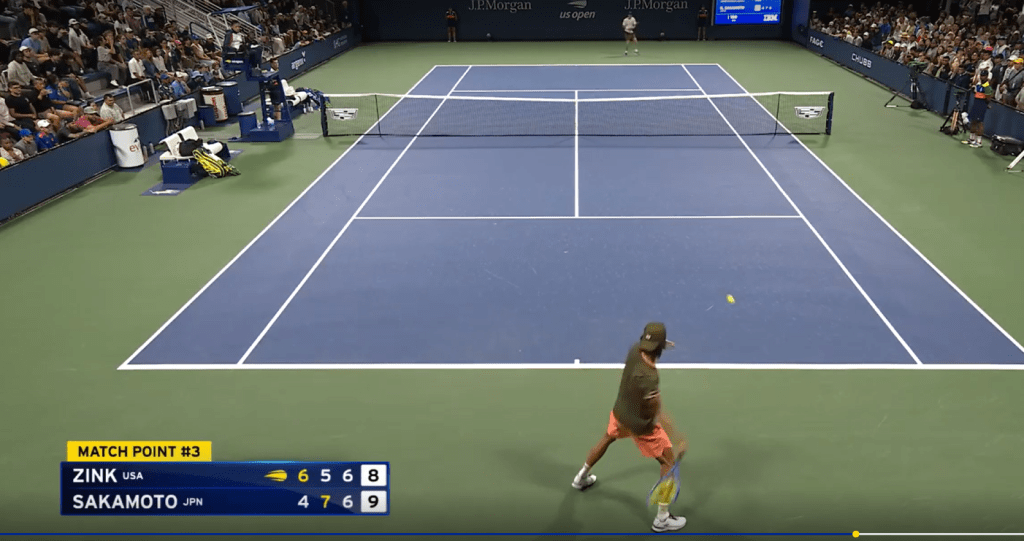
The stadium erupted in a roar so loud it rattled the rafters. Sakamoto stood motionless for a second, as if to confirm that it was real. Then he let his body fall backward onto the court, arms flung wide, chest heaving, staring up at the lights. He lay there, drinking in the sound of victory — not just his, but a victory of spirit itself. Slowly, he rose to his feet, lifted his racket, and performed his signature gesture: the bow of a samurai, hand sliding across his chest as if unsheathing and sheathing an invisible sword. The crowd roared louder still, enchanted by the symbolism, by the grace of his discipline. Moments later, he walked to the edge of the court, signing autographs , including mine, pressing forward with shining eyes, his face calm, smiling, as though he had merely fulfilled his duty.
What stayed with me was not only the comeback, but the lesson it carried. The scoreboard had declared him finished at 5–1. But Sakamoto showed us that the scoreboard lies. It measures the present moment, but it does not capture the future waiting to be written.
How many of us live our own “5–1 moments”? We find ourselves in a relationship that drains our joy, convinced we will never escape. We sit in jobs that strip us of meaning, thinking change is impossible. We chase dreams that seem too far out of reach, our failures stacking like lost games until surrender feels inevitable. In such times, despair whispers, “It’s over.” But Sakamoto teaches otherwise: the match is not over until you decide to stop playing your best game.
Tyler’s unraveling at 5–1, too, speaks to us. Standing on the edge of victory is sometimes the heaviest burden of all. Success invites nerves, complacency, or fear of finishing — and life is full of such thresholds. How many of us falter just before the finish line, undone not by our inability but by our doubt?
Yet what endures is not Tyler’s stumble but Sakamoto’s resolve. He reminds us that perseverance is not always dramatic. Sometimes it is as quiet as a breath taken before a serve, as simple as showing up for the next point, the next step, the next chance. His samurai bow was more than a celebration — it was a symbol of what it means to honor the fight, to face the impossible with dignity, and to persist when surrender would be easier.
When I left the stadium that night, I carried more than the memory of a match. I carried a truth etched in sweat, sound, and silence: that resilience is always available to us. That comebacks are not reserved for athletes but belong to anyone willing to fight point by point, breath by breath. That even when life has us down 5–1, the story is not finished.
And so, whenever I feel tempted to surrender — to give up on a dream, to remain in a place that harms me, to accept defeat too soon — I will remember Sakamoto on that court: falling to the ground in disbelief, rising with the gesture of a samurai, reminding us all that the match is never over until the scoreboard stops lying.
It is a call not to give up but to find the confidence, the certainty of being able, capable. determined to follow the inner guidance to get the desired results even some impossible ones, the inconceivable project one have been postponing, that personal puzzle unsolved until now.
I bet you have similar experiences I could relate to. Send me a note! and share it!
Thank you for reading my blog. Remember to follow me on social media @JBRadiant and visit my webpage to find out about my ongoing projects.


Tennis (and baseball) are unique in that you have to earn every point till the end. You cant build a big lead and have the clock run out the victory like football, basketball, soccer, and hockey.
What is devastating for Tyler is not so much that he let a big lead disappear and lose the match, is that at 24 (not so young in tennis years), he was trying to make the main draw of the US open. His match was the first of 3 qualifyers. He made 27K for qualifying. Would have made 42K if won (as Sakamoto did), and 57K if he won his 3rd qualifyer. That would have put him in the main draw of the US open where he would have earned 110K. The winner of the US open gets 5 million.
Sakamoto at 19 still has some time to work on his game, and keep trying to win matches, and will certainly get a huge boost of confidence that he can always come back no matter what the deficit.
Tyler will need to re-examine why and how he lost and work with his coaching staff, family, and decide whats next cause at 24, time is NOW!
Coaching, travel, hotel, entry fees are super expensive. Winning these qualifyers are everything!!
It is a tough life! Kinda like when you do great work on a project at work, then given something new to do and you are having trouble. The boss just thinks….’What have you done for me lately?’
Good luck to both of them. So many talented young players sacrificing their lives and bodies and so few achieve a living in professional tennis.
LikeLiked by 1 person
In the Spanish La Liga, which I’m a big fan of, this is called ‘Remontada’ and it’s amazing when it happens… it’s aslo a very good life lesson… it ain’t over till it’s over ❤ ❤
LikeLiked by 1 person